Table of Contents
Gone are the days when public relations (PR) was about press releases and media coverage. In 2026, it has evolved into a dynamic, data-driven, and technology-powered discipline that sits at the intersection of storytelling, analytics, and digital influence.
With the rise of artificial intelligence, changing consumer expectations, and the transformation of media consumption habits, PR professionals must rethink how they communicate, engage, and build trust.
From AI-powered tools like ChatGPT to emerging concepts like Generative Engine Optimization (GEO), the industry is undergoing a fundamental shift. To succeed in this competition, PR teams must align with these trends.
This blog explores the most important PR trends in 2026, helping brands and marketers stay ahead in an increasingly competitive and fast-evolving landscape. Here’s how:
Top PR Trends for 2026
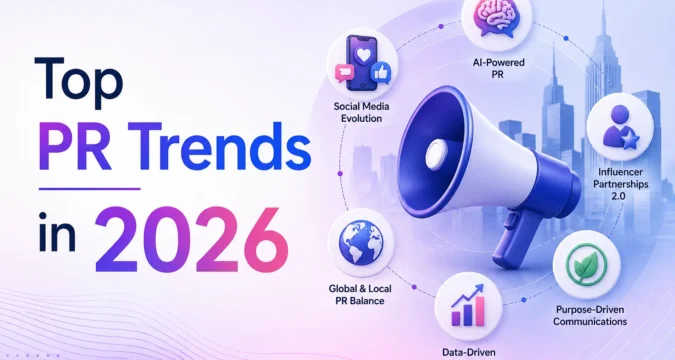
The top PR trends for 2026 include AI-powered PR automation, hyper-personalized communication, the rise of creator & influencer, and more. Adhering to these trends and implementing those will bring the most out of your PR strategy, allowing your business to grow more. Here’s all you need to know about these top PR trends:
AI-Powered PR & Automation
Artificial Intelligence is at the core of modern PR strategies in 2026. It has transformed how campaigns are planned, executed, and measured. AI tools are now widely used for:
- Media monitoring and sentiment analysis
- Drafting press releases and content
- Identifying trending topics and journalists’ interests
- Predicting campaign performance using historical data
Platforms like ChatGPT enable PR professionals to generate content faster, but human creativity remains essential for crafting compelling narratives.
However, over-reliance on AI can lead to generic messaging. The most successful PR strategies strike a balance between automation and human insight.
Hyper-Personalization in Communication
Mass communication is becoming obsolete. In 2026, audiences expect personalized and relevant messaging. Therefore, businesses are considering hyper-personalized communication. PR teams now leverage data analytics to:
- Segment audiences based on behavior and preferences
- Tailor media pitches to specific journalists
- Deliver customized brand stories to different audience groups
Hyper-personalization improves engagement, builds stronger relationships, and increases the chances of media coverage. Instead of sending the same press release to hundreds of journalists, PR professionals are now changing their strategies and crafting highly targeted pitches, resulting in better outcomes.
Rise of Creator & Influencer PR
There are differences between traditional PR and digital PR, and one of them is how the rise of creator and influencer PR is sharing the role of traditional PR. The rise of creators and influencer public relations is the trend now. Key shifts include:
- Increased reliance on micro and nano influencers
- Long-term brand-creator partnerships
- Focus on authenticity over follower count
Influencers offer direct access to niche audiences, making them a critical component of modern PR strategies.
Brands that collaborate with creators authentically, not just for promotion, build deeper trust and credibility.
Video-First & Short-Form Content Dominance
Video content continues to dominate digital platforms in 2026. Short-form videos, in particular, are reshaping how brands communicate with their target audiences. This PR trend and strategies now include:
- Reels, Shorts, and bite-sized storytelling
- Live streaming events and product launches
- Behind-the-scenes content to humanize brands
This proves to be effective because visual storytelling captures attention faster and drives higher engagement compared to traditional text-based communication. For PR professionals, mastering video content is no longer optional; it’s essential to be in the competition.
Data-Driven PR & Advanced Measurement
One of the most influential PR trends in 2026 includes data-driven PR and advanced measurement. Yes, now PR is becoming more accountable and measurable than ever before.
Instead of focusing solely on impressions or media mentions, modern businesses and teams measure PR ROI. These teams track:
- Engagement metrics
- Website traffic from PR campaigns
- Lead generation and conversions
- Sentiment analysis and brand perception
Real-time analytics tools, such as Meltwater, Onclusive, and Brandwatch, enable PR professionals to optimize campaigns on the go, making PR a performance-driven function. This shift also helps PR align more closely with marketing and business goals.
PR Meets GEO (Generative Engine Optimization)
One of the most important emerging trends in 2026 is Generative Engine Optimization (GEO). Traditionally, PR and SEO worked hand in hand, as PR supported SEO by earning backlinks and media coverage.
But now, with AI-driven platforms like Google Gemini and Microsoft Copilot, the focus is shifting toward being cited in AI-generated responses. What does this mean for PR? This means:
- Authority matters more than ever
- AI tools prioritize credible, well-structured, and authoritative content
- Brand mentions over backlinks
- Even unlinked mentions in high-quality sources can influence AI outputs
- Structured content wins
- Clear, factual, and well-organized PR content increases visibility
- Thought leadership is key
- Experts, founders, and original insights are more likely to be referenced
GEO does not replace SEO; it enhances it. PR plays a central role in this evolution by building brand authority and trust signals across the web.
ESG & Purpose-Driven PR
Consumers in 2026 expect brands to stand for something beyond profits. Environmental, Social, and Governance (ESG) communication has become a critical part of PR. Now, brands are focusing on sustainability initiatives, social responsibility efforts, and ethical business practices.
However, audiences are increasingly skeptical. Any inconsistency can lead to accusations of greenwashing. Therefore, successful ESG PR requires:
- Transparency
- Authentic storytelling
- Verifiable data and impact
Purpose-driven communication is no longer optional, but a necessity for building long-term trust.
Crisis Management in the Digital Age
Efficient crisis management is one of the key PR trends in 2026. This is because in today’s hyper-connected world, a crisis may escalate within minutes. Social media and digital platforms amplify both information and misinformation, making crisis management more challenging. Modern PR teams must:
- Monitor conversations in real time
- Respond quickly and accurately
- Prepare crisis communication plans in advance
- Use social listening tools to detect early warning signs
The key to effective crisis management is speed, transparency, and accountability. It helps businesses with reputation management.
Decentralized Media & Owned Channels
Brands are no longer fully dependent on traditional media. In today’s world, owned channels such as blogs, newsletters, podcasts, and community platforms are becoming central to PR strategies. This shift allows brands to:
- Control their narrative
- Build direct relationships with audiences
- Reduce reliance on media gatekeepers
Owned media is not just a marketing tool. It’s a powerful PR asset for excellent public relations for businesses.
Voice Search & Conversational PR
The way people search for information is changing. Yes, in 2026, voice search and conversational PR are the trends.
With the rise of voice assistants, users now ask questions in a conversational manner rather than typing keywords. So, today’s PR strategies must adapt by:
- Creating content that answers questions directly
- Using natural, conversational language
- Structuring information for easy comprehension
This trend is closely linked with GEO, as both focus on how information is discovered through AI-driven systems.
Employee Advocacy & Internal PR
Employees are becoming influential brand ambassadors. In 2026, internal PR is just as important as external communication. Therefore, organizations are:
- Encouraging employees to share brand stories
- Building strong internal communication systems
- Promoting personal branding on platforms like LinkedIn
Authentic employee voices often carry more credibility than corporate messaging.
Privacy, Trust & Ethical PR
With increasing data privacy regulations, trust has become a key differentiator. And that’s why privacy, trust, and ethical PR are the trends.
So, now PR professionals must ensure transparent communication practices, responsible use of data, and ethical storytelling.
Consumers are more aware and cautious, making trust-building a long-term priority. Brands that prioritize ethics and transparency will stand out in a crowded market.
Integration of PR with Marketing & SEO
SEO, digital marketing, and public relations are no longer separate functions; they are deeply interconnected. Modern PR contributes to:
- Improving search rankings through digital PR
- Building brand authority
- Supporting content marketing strategies
This integration ensures consistent messaging across all channels and maximizes overall impact. What’s more, it also strengthens both SEO and GEO performance, making PR a critical component of digital growth.
Tools & Technologies Shaping PR in 2026
Adhering to trends is important; however, tools play a critical role in how you execute PR strategies. Therefore, you must know the key tools and technologies that are shaping PR in 2026. Key tools include:
- AI-powered content and research platforms
- Media monitoring and social listening tools
- CRM systems for relationship management
- Analytics platforms for performance tracking
The right tools enable PR teams to work more efficiently and make data-driven decisions.
Key Challenges in Adopting PR Trends
Adopting current Public Relations (PR) trends is challenging due to the need for rapid adaptation in a 24/7 digital environment, the pressure to prove ROI, and the ethical risks associated with AI.
Key challenges include balancing proactive strategy with constant reactive, real-time crisis management, managing a fragmented media landscape, and maintaining authenticity amid high-volume content production. Here’s how:
- AI Integration and Ethical Risks: Mitigating bias, ensuring data privacy, and maintaining authentic, human-led storytelling rather than robotic, automated content is one of the key challenges with AI integration.
- Measuring ROI and Business Impact: A persistent challenge is moving beyond vanity metrics, like impressions and reach, to prove that PR drives tangible business goals, such as revenue and customer acquisition.
- Reactive vs. Proactive Focus: PR teams often get caught in a reactive cycle, dealing with immediate crises and social media backlashes rather than implementing long-term, proactive reputation management.
- Media Fragmentation & Digital Adaptation: The decline of traditional media and the rise of niche influencers and social platforms make it difficult to target audiences effectively. PR teams struggle to shift from broad pitching to fragmented, audience-first targeting.
- Resource and Budget Pressures: 58% of PR professionals in 2026 reported resource pressures as a top challenge. This is because tight budgets force teams to prove their value to avoid being the first function cut.
- Managing Misinformation: The speed at which false information spreads necessitates continuous monitoring and rapid, strategic responses to prevent lasting reputational damage.
How to Overcome These Challenges
- Create a Dedicated Trend-Spotting Team: Build a group to monitor new platforms and tools.
- Implement AI for Efficiency, Not Replacement: Make use of AI for routine tasks like media monitoring and sentiment analysis. However, keep humans in charge of strategy and creativity.
- Focus on Employee Advocacy: Utilize employees as brand advocates to build authentic trust. That’s because they are often seen as more credible than external influencers.
- Align PR with Marketing & Sales: Collaborate with other departments to establish shared KPIs for better ROI reporting.
Best Practices for Future-Ready PR
From blending AI with human creativity to focusing on authority for GEO and more, there are best practices for the future-Ready PR. Here’s all about these practices you should know:
- Blend AI with Human Creativity: Use tools like ChatGPT for efficiency, but rely on human insight for storytelling, emotional connection, and brand voice.
- Focus on Authority for GEO: Create well-researched, factual, and structured content to increase chances of being cited by AI platforms like Google Gemini.
- Prioritize Quality Over Quantity: Fewer, high-impact media placements and meaningful stories outperform mass press releases and generic outreach.
- Invest in Data-Driven Decision Making: Track metrics like engagement, sentiment, and conversions, not just impressions, to refine PR strategies continuously.
- Build Authentic Media & Creator Relationships: Focus on long-term partnerships with journalists and influencers rather than one-off collaborations.
- Adopt a Multi-Channel Storytelling Approach: Distribute PR content across blogs, social media, video platforms, podcasts, and newsletters for maximum reach.
- Optimize PR Content for SEO and GEO: Use clear structure, credible sources, and keyword relevance to improve both search rankings and AI visibility.
- Strengthen Crisis Preparedness: Have a proactive crisis communication plan with real-time monitoring and rapid response mechanisms.
- Promote Transparency and Ethical Communication: Be honest, consistent, and accountable to build long-term trust with audiences.
- Leverage Employee Advocacy: Encourage employees to share brand stories and insights to amplify reach and authenticity.
- Stay Agile and Continuously Upskill: Keep learning new tools, technologies, and trends to remain competitive in a rapidly evolving PR landscape.
- Align PR with Business Goals: Ensure PR efforts contribute directly to brand awareness, reputation, and revenue growth.
Conclusion
Public Relations in 2026 is more than gaining media coverage. It’s about building trust, authority, and meaningful influence in a rapidly evolving digital ecosystem. As AI reshapes communication, tools like ChatGPT are accelerating content creation, while platforms such as Google Gemini are redefining how audiences discover information.
From hyper-personalized storytelling and creator collaborations to data-driven strategies and the rise of Generative Engine Optimization (GEO), PR is becoming more strategic, measurable, and integrated than ever before.
At the same time, core principles, like authenticity, transparency, and strong relationships, remain the foundation of successful PR. The brands that will lead in 2026 are those that embrace innovation without losing their human voice.
By combining technology with genuine storytelling and staying adaptable to change, businesses can not only keep up with the future of PR but also actively shape it.
Ultimately, PR is evolving from simply managing reputation to driving intelligent, credible, and lasting influence in an AI-powered world.
FAQs
What are the most important PR trends in 2026?
The biggest PR trends include AI-powered automation, hyper-personalization, influencer PR, video-first content, data-driven measurement, ESG communication, and the rise of Generative Engine Optimization (GEO).
How is AI changing public relations in 2026?
AI tools like ChatGPT are transforming PR by automating content creation, improving media monitoring, enabling sentiment analysis, and predicting campaign outcomes, thereby making PR faster and more data-driven.
What is Generative Engine Optimization (GEO) in PR?
GEO refers to optimizing content so it gets cited by AI platforms like Google Gemini and ChatGPT. In PR, this means focusing on authority, structured content, and credible brand mentions.
Is GEO replacing SEO in 2026?
No, GEO is not replacing SEO. Instead, it complements SEO. While SEO focuses on search rankings, GEO focuses on visibility in AI-generated responses. Both are crucial for modern PR strategies.
Why is influencer PR more important than traditional media now?
Influencers and creators have direct access to niche, highly engaged audiences. Their content is often perceived as more authentic, making them powerful partners for modern PR campaigns.
How can PR professionals measure success in 2026?
Professionals measure PR success through engagement metrics, sentiment analysis, website traffic, lead generation, and conversions, not just media mentions or impressions.
What role does video play in PR strategies?
Video, especially short-form content, is crucial for storytelling, engagement, and brand visibility. It allows brands to communicate quickly and effectively in a content-saturated environment.
What is the role of ESG in PR today?
ESG (Environmental, Social, and Governance) communication helps brands build trust by showcasing ethical practices, sustainability efforts, and social responsibility.
How can brands prepare for PR crises in the digital age?
Brands should use social listening tools, have a crisis communication plan, respond quickly, and maintain transparency to manage crises effectively.
Why is personalization important in PR?
In public relations, personalized communication increases relevance, improves engagement, and builds stronger relationships with both media professionals and target audiences.
What are owned media channels in PR?
Owned media includes platforms like blogs, newsletters, and podcasts that brands control. These channels allow direct communication with audiences without relying on traditional media.
How does PR support SEO and digital marketing?
PR helps earn high-quality backlinks, increases brand mentions, and improves online authority, boosting both SEO rankings and overall digital visibility.
What skills are essential for PR professionals in 2026?
Key skills for PR professionals in 2026 include data analysis, AI tool usage, storytelling, crisis management, digital marketing integration, and adaptability to new technologies.
What are the biggest challenges in modern PR?
Major challenges include keeping up with technology, maintaining authenticity, measuring ROI accurately, and managing misinformation or crises.