Table of Contents
Public Relations (PR) has always been about shaping perception, building trust, and maintaining relationships between brands and their audiences. However, in today’s fast-paced digital world, traditional PR methods are no longer enough for maximum output.
That’s where AI in PR comes in. Be it PR for FinTech or real estate, the rise of Artificial Intelligence (AI) is transforming how PR professionals work, making campaigns smarter, faster, and more data-driven.
From media monitoring to crisis management, AI is revolutionizing every aspect of PR. It enables brands to analyze massive amounts of data, predict trends, automate tasks, and deliver highly personalized communication at scale.
This blog explores how AI is reshaping public relations, its benefits, challenges, tools, and what the future holds for PR professionals. What’s more, it also suggests steps to implement AI in PR, allowing you to make use of it and make the most out of your PR strategy.
What Is AI in PR?
AI in Public Relations refers to the use of artificial intelligence technologies, such as machine learning, natural language processing (NLP), and predictive analytics, to enhance PR strategies and operations.
Unlike traditional PR, which relies heavily on manual research, intuition, and relationships, AI-powered PR uses data and automation to improve decision-making and efficiency.
Key Technologies Used in AI-Powered PR:
- Machine Learning (ML): Learns from data to improve predictions and insights
- Natural Language Processing (NLP): Understands and analyzes human language
- Predictive Analytics: Forecasts trends and outcomes
- Automation Tools: Streamline repetitive tasks like reporting and outreach
Why AI Matters in Public Relations
The PR landscape has changed because of digital transformation. Brands are now dealing with massive volumes of online data, real-time news cycles, increasing demand for personalization, and high competition for audience attention.
Using AI in PR helps professionals manage this complexity by providing real-time insights, automating processes, and improving targeting. Here are the key reasons AI is important in PR you should know:
- Handles large-scale data efficiently
- Enables faster response times
- Enhances audience understanding
- Improves campaign accuracy and effectiveness
Key Applications of AI in PR
Artificial Intelligence is not just enhancing PR, it is fundamentally reshaping how communication strategies are planned, executed, and measured. From data analysis to real-time engagement, AI enables PR professionals to operate with greater precision, speed, and impact.
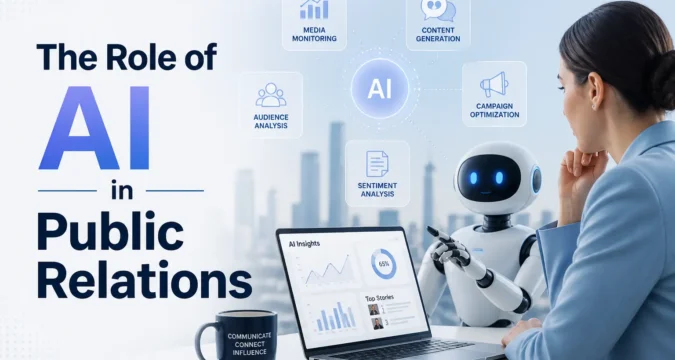
Here are a few of the most important applications of AI in modern public relations, including media monitoring, sentiment analysis, content creation & optimization and more:
Media Monitoring & Sentiment Analysis
AI-powered media monitoring tools like Talkwalker and Onclusive allow PR professionals to track brand mentions across thousands of digital sources, including news websites, blogs, forums, and social media platforms, all in real time.
More importantly, AI goes beyond simple tracking. Using Natural Language Processing (NLP), it analyzes the tone and context of conversations to determine whether sentiment is positive, negative, or neutral. This way, AI helps PR teams:
- Gain instant insights into public perception
- Detect potential reputation risks early
- Measure PR ROI and the effectiveness of PR campaigns
- Understand audience emotions and reactions
For example, if a sudden spike in negative sentiment is detected after a product launch, PR teams can quickly investigate and respond before the issue escalates.
Content Creation & Optimization
AI has significantly streamlined the content creation process in PR. Today, AI tools can assist PR professionals in generating press releases, blog articles, social media posts, email pitches and newsletters. Beyond creation, AI also plays a critical role in content optimization. It can:
- Suggest high-performing keywords for SEO
- Recommend engaging headlines
- Improve readability and structure
- Analyze content performance
This ensures that PR content is not only well-written but also search-engine friendly and audience-focused.
However, while AI improves efficiency, it lacks human creativity, emotional intelligence, and storytelling depth. Therefore, the most effective PR strategies combine AI-generated insights with human creativity.
Predictive Analytics
Predictive analytics is one of the most powerful applications of AI in PR. By analyzing historical data and current trends, artificial intelligence can forecast future outcomes and behaviors. This includes predicting:
- Emerging media trends
- Audience preferences and engagement patterns
- Potential campaign performance
- Risk factors that could impact brand reputation
With these insights, PR professionals have the ability to shift from a reactive approach to a proactive strategy.
For instance, if AI identifies that a particular topic is gaining traction, brands can create relevant content early and position themselves as thought leaders in that space.
Chatbots & Customer Engagement
AI-powered chatbots have transformed how brands interact with their audiences. They provide instant, 24/7 communication, ensuring that no customer query goes unanswered. Chatbots can:
- Respond to frequently asked questions
- Assist with customer support
- Handle complaints and feedback
- Guide users through services or products
This level of responsiveness enhances the overall customer experience and strengthens brand trust.
In PR, chatbots also play a role in maintaining consistent communication during high-traffic events, product launches, or even crises, when immediate responses are crucial.
Influencer Identification
Influencer PR and marketing is a key component of modern PR, but finding the right influencer can be challenging. AI simplifies this process by analyzing large datasets to identify the most suitable influencers for a brand. AI tools evaluate:
- Audience demographics and interests
- Engagement rates and content performance
- Authenticity of followers (detecting fake followers)
- Brand alignment and relevance
This ensures that PR campaigns are not just reaching large audiences, but the right audiences.
As a result, brands can build more authentic partnerships and achieve better ROI from influencer collaborations.
Crisis Management
In today’s digital world, a PR crisis is likely to escalate within minutes. AI helps organizations stay ahead by providing early warning systems and real-time insights. AI can:
- Detect sudden spikes in negative sentiment
- Monitor viral trends and conversations
- Alert PR teams instantly
- Recommend data-driven response strategies
This enables brands to respond quickly, minimize damage, and maintain control over the narrative.
For example, if misinformation about a brand starts spreading online, AI tools can identify the source, track its reach, and help PR teams craft timely and effective responses.
Benefits of AI in Public Relations
Artificial Intelligence is not just a technological upgrade in PR, but a strategic advantage. By combining automation, data analysis, and real-time insights, AI enables PR professionals to work smarter, respond faster, and deliver more impactful campaigns. Here are the key benefits explained in depth:
Faster Decision-Making
In traditional PR, decision-making often depends on manual research, delayed reports, and intuition. AI changes this by providing real-time data and instant insights. With AI tools, PR teams can:
- Monitor live media coverage and social conversations
- Identify trends as they emerge
- Respond quickly to opportunities or threats
This speed is especially critical during crises or viral moments, where even a small delay can impact brand reputation. AI ensures that PR professionals can make timely and informed decisions without waiting for manual analysis.
Data-Driven Insights
AI enables PR strategies to move from guesswork to evidence-based decision-making. By analyzing large volumes of data from multiple sources, AI provides insights into:
- Audience behavior and preferences
- Content performance
- Media coverage trends
- Campaign effectiveness
This allows PR professionals to understand what works and what doesn’t, refine messaging based on real audience feedback, and create more targeted and impactful campaigns. As a result, PR becomes more measurable, strategic, and results-oriented.
Cost Efficiency
AI helps reduce operational costs by automating repetitive and time-consuming tasks such as media monitoring, report generation, data analysis, and basic content creation.
This reduces the need for extensive manual effort and allows teams to optimize resource allocation.
For smaller businesses or startups, AI tools provide access to capabilities that were once only available to large PR agencies, making advanced PR strategies more accessible and scalable.
Improved Targeting and Personalization
Modern audiences expect personalized communication, and AI makes it possible to deliver this at scale. It analyzes user data to segment audiences based on interests and preferences, online behavior, demographics and engagement patterns. This enables PR teams to:
- Craft tailored messages for different audience segments
- Deliver the right content at the right time
- Increase engagement and relevance
Personalized communication not only improves audience connection but also strengthens brand loyalty and trust.
Enhanced Campaign Performance Tracking
Measuring PR success has always been challenging, but AI simplifies and enhances this process. AI-powered analytics tools can:
- Track key performance indicators (KPIs) in real time
- Measure media reach, engagement, and sentiment
- Provide detailed reports and dashboards
- Identify areas for improvement
This allows PR professionals to continuously optimize campaigns, demonstrate clear ROI to stakeholders, and make data-backed adjustments for better results.
Challenges of Using AI in Public Relations
While AI offers numerous benefits for public relations, it also comes with challenges. Here are a few of the challenges of AI-powered PR:
- Lack of Human Creativity: AI cannot fully replicate human emotions, intuition, and storytelling.
- Data Privacy Concerns: Handling large amounts of data raises ethical and legal issues.
- Over-Reliance on Automation: Excessive dependence on AI may reduce authenticity.
- Implementation Costs: Advanced AI tools can be expensive for small businesses.
- Risk of Misinformation: AI-generated content may sometimes produce inaccurate or misleading information.
AI Tools in Public Relations
AI has introduced a wide range of tools that make PR more efficient, data-driven, and scalable. These tools help professionals monitor reputation, create content, understand audiences, and manage campaigns effectively. Here’s how:
Media Monitoring Tools
Media monitoring tools like Hootsuite and more help track how and where a brand is being mentioned across digital and traditional media. They also analyze the tone of conversations.
Key functions:
- Track brand mentions in real time
- Analyze sentiment, like positive, negative, and neutral
- Measure media coverage and visibility
Content Generation Tools
AI-powered content tools, such as ChatGPT, Gemini, and more, assist in creating and refining PR content quickly and effectively.
Key functions:
- Generate press releases, blogs, and social media posts
- Improve readability and structure
- Suggest SEO-friendly keywords and headlines
Social Listening Tools
There are social listening tools available out there including Talkwalker and Sprout Social that help PR teams understand what audiences are saying online and identify emerging trends.
Key functions:
- Monitor conversations across social platforms
- Detect trending topics and public opinions
- Gather audience insights for better messaging
Analytics & Reporting Tools
AI-driven analytics tools like ThoughtSpot and more help PR professionals measure the success of PR campaigns with accurate data. This level of measurement helps brands navigate their strategies in the right way for maximum outcomes.
Key functions:
- Track campaign performance in real time
- Measure engagement, reach, and sentiment
- Generate automated performance reports
CRM & Automation Platforms
CRM & automation platforms are the best tools for AI-powered PR. These tools streamline communication and relationship management in PR.
Key functions:
- Manage media and stakeholder relationships
- Automate outreach and follow-ups
- Improve organization of contacts and interactions
How to Integrate AI in Your PR Strategy
Adopting AI in PR isn’t just about using new tools; it’s about aligning technology with your communication goals and workflows. Here’s a clear, practical approach to integrating AI in your PR:
Define Clear Objectives
Start with a predefined and strong foundation by identifying what you want to achieve. Your goals will guide how you use AI. Common PR objectives may include:
- Increasing brand awareness
- Gaining media coverage
- Managing crises effectively
- Improving audience engagement
Having clear goals ensures your AI efforts remain focused and measurable.
Choose the Right Tools
Not all AI tools serve the same purpose. Therefore, select tools that match your specific needs and budget. When choosing tools, consider measuring the features and capabilities, ease of use, integration, and scalability for future growth.
When you choose the right tools, they help you enhance efficiency without overcomplicating your workflow.
Balance AI with Human Creativity
AI excels at data analysis and automation, but PR still relies heavily on storytelling and emotional connection. You should balance AI with human creativity. The best approach should be to:
- Use AI for insights, research, and efficiency
- Let humans handle messaging, creativity, and relationships
This balance ensures your communication remains authentic and impactful, which is crucial for a better outcome PR strategy.
Train and Upskill Your Team
To fully benefit from AI, your PR team must understand how to use it effectively. Therefore, you should train and upskill the team to capitalize on PR initiatives. For this to be possible, focus on:
- Tool training and hands-on practice
- Understanding data insights
- Adapting to AI-driven workflows
A skilled team is more likely to turn AI capabilities into real results.
Monitor, Analyze, and Optimize
AI provides continuous data, so use it to refine your strategy over time. When you monitor, you get the chance to improve how you do it, and when you optimize the way you do it, you open the doors for improved ROI of public relations strategies. Key actions for this include:
- Tracking campaign performance
- Analyzing audience response and engagement
- Adjusting strategies based on insights
Ongoing PR optimization ensures your PR efforts stay relevant and effective.
Future of AI in Public Relations
The future of PR is deeply connected with AI. Be it hyper-personalization, voice and visual AI, or AI-powered storytelling, AI is reshaping the future of PR. Here’s what to expect:
- Hyper-Personalization: AI will enable highly tailored communication for individual users.
- Voice and Visual AI: PR strategies will include voice search optimization and visual content analysis.
- AI-Driven Storytelling: AI will assist in crafting compelling narratives based on data insights.
- Ethical AI Practices: Transparency and responsible use of AI will become critical.
- Evolving Role of PR Professionals: PR professionals will focus more on strategy, creativity, and relationship-building, while AI handles repetitive tasks.
Conclusion
AI is no longer a futuristic concept in Public Relations; it is a present-day necessity. It empowers PR professionals to work smarter, respond faster, and create more impactful campaigns.
However, the key to success lies in balance. While AI offers efficiency and insights, human creativity and emotional intelligence remain irreplaceable.
By integrating AI thoughtfully into PR strategies, brands can stay ahead of the competition and build stronger, more meaningful connections with their audiences.
Explore traditional PR vs digital PR; if you’re unable to differentiate between them, for better decision-making.
FAQs
What is AI in Public Relations (PR)?
AI in PR refers to the use of artificial intelligence technologies like machine learning, natural language processing, and data analytics to improve communication strategies, automate tasks, and enhance decision-making in public relations.
How is AI changing the PR industry?
AI is transforming PR by enabling real-time media monitoring, automated content creation, predictive analytics, and personalized communication, making PR campaigns more efficient and data-driven.
Can AI replace PR professionals?
No, AI cannot replace PR professionals. While AI handles data analysis and automation, human creativity, emotional intelligence, and strategic thinking are still essential in storytelling and relationship building.
What are the main benefits of AI in PR?
The key benefits of using AI in PR include faster decision-making, improved targeting, cost efficiency, better campaign tracking, and data-driven insights. They help optimize PR strategies.
How is AI used in media monitoring?
AI tracks brand mentions across news, blogs, and social media in real time and analyzes sentiment to determine whether public perception is positive, negative, or neutral.
What role does AI play in crisis management?
AI helps in crisis management by detecting early warning signs of a PR crisis by monitoring sudden spikes in negative sentiment and alerting teams so they can respond quickly and protect brand reputation.
Which AI tools are used in PR?
Common AI tools in PR include media monitoring platforms, social listening tools, content generation tools, analytics dashboards, and influencer identification platforms.
How does AI help in content creation for PR?
AI assists in generating press releases, blog posts, and social media content while also optimizing them for SEO by suggesting keywords, headlines, and structure improvements.
Is AI in PR suitable for small businesses?
Yes, AI is highly beneficial for small businesses as it reduces costs, automates tasks, and provides access to advanced PR capabilities that were previously limited to large organizations.
What is the future of AI in Public Relations?
The future of AI in PR includes hyper-personalized communication, AI-driven storytelling, advanced predictive analytics, and stronger integration between human creativity and machine intelligence.