
Table of Contents
Public relations plays an important role in shaping how organizations communicate with the public, media, and stakeholders. From building brand reputation to gaining valuable media coverage, PR campaigns help businesses strengthen their visibility and credibility in the marketplace.
For example, the Pepsi Refresh Project (PRP) generated more than 80 million votes, and 37% of Americans were aware of the Refresh Project, evidencing the success of PR.
However, as organizations invest time, effort, and financial resources into public relations activities, it becomes increasingly important to understand whether these efforts are delivering meaningful results. And that’s where measuring PR ROI becomes crucial.
Measuring PR return on investment (PR ROI) allows organizations to evaluate the effectiveness of their communication strategies and determine how PR contributes to broader business goals.
By tracking key metrics such as media coverage, audience reach, website traffic, and brand sentiment, companies can gain clearer insights into the value generated from their PR initiatives. Understanding how to measure PR ROI not only helps justify PR investments but also guides more informed and effective strategies in the future.
This blog explains how to measure PR ROI, allowing you to know, measure, and make informed decisions for your PR strategy.
What Is PR ROI?
PR ROI (Return on Investment) measures the profitability and efficiency of public relations activities relative to their cost. It determines if the value generated, such as increased brand awareness, website traffic, or sales, exceeds the investment, helping to prove that PR efforts, whether direct or indirect, are contributing to business goals.
Key Elements of PR ROI:
- Definition: It evaluates whether the value produced by PR efforts, for example, reputation and leads are greater than the cost of the investment.
- Types of Returns: Returns can be monetary, like direct sales and increased revenue, or earned media gains, like higher credibility and better reputation.
- Measurement Metrics: Common PR metrics include website traffic, lead generation, share of voice (SoV), media mentions & reach, and conversion rates.
- Purpose: It allows organizations to justify PR spending, identify high-yielding, cost-effective strategies, and connect campaign results to business objectives.
8 Ways to Measure PR ROI
Media coverage, media reach, share of voice, website traffic from PR, social media engagement, and more are the ways to measure PR ROI. Here’s how you can do it:
1. Media Coverage
Media coverage is one of the most direct indicators of PR performance. It involves tracking how often your brand appears in newspapers, online publications, industry magazines, television segments, or podcasts. However, the number of mentions alone isn’t enough. The credibility of the publication, the relevance of its audience, and whether your brand is the main focus of the story all influence the actual value of that coverage.
2. Media Reach
Media reach refers to the estimated size of the audience that may have seen your brand through PR placements. This includes the readership of newspapers, the viewership of TV programs, or the monthly visitors to online publications. Although reach represents potential exposure rather than guaranteed views, it helps you get an understanding of the scale of visibility your PR efforts are generating across different media channels.
3. Share of Voice (SOV)
Share of voice measures how prominently your brand appears in media conversations compared to competitors. If several companies operate in the same industry, analyzing which brand receives the most mentions or coverage reveals relative market visibility.
A higher share of voice generally suggests a stronger media presence and influence. It indicates that your PR strategy is successfully positioning the brand within industry discussions.
4. Website Traffic from PR
PR campaigns often drive people to search for or visit a company’s website after encountering a news article or media mention. By monitoring referral sources and traffic spikes in analytics platforms, such as Google Analytics, organizations are likely to determine whether specific press releases, interviews, or articles are driving audiences to explore their website and learn more about the brand.
5. Social Media Engagement
Public relations coverage frequently sparks conversations on social media platforms. Tracking increases in likes, shares, comments, mentions, and follower growth during or after a PR campaign helps determine how audiences are reacting. High engagement usually indicates that the message resonated with the public and encouraged people to interact with or discuss the brand online.
6. Brand Sentiment
Brand sentiment evaluates the tone of public conversations surrounding your company after PR activities. By analyzing whether mentions in articles, social media posts, or online discussions are positive, neutral, or negative, you can simply understand how your reputation is evolving.
Bear it in mind that positive sentiment generally signals successful communication and trust-building, while negative sentiment may highlight areas that require improved messaging.
7. Lead Generation
An effective PR campaign can indirectly contribute to lead generation and new business opportunities. Organizations often monitor the number of inquiries, newsletter subscriptions, product demo requests, or account sign-ups that occur following media coverage.
Although PR does not always produce immediate sales, increased interest and inquiries indicate that media exposure is influencing potential customers to take the next step.
8. Cost vs Value Analysis
Last but not least! In order to evaluate PR ROI, you should compare the resources invested in PR activities with the outcomes achieved. Costs may include agency fees, campaign production, events, or internal staff time. You can weigh these expenses against benefits such as media exposure, audience reach, website traffic, and brand awareness.
Through this comparison, you can determine whether their PR strategy is delivering meaningful value or not.
Why Measuring PR ROI Is Important
Measuring PR ROI is important for various reasons, for example, it helps you know whether your PR strategy is bringing value, justify PR budget, improve figure strategies, and more. Once you know the real-time outcomes through measurements, you’re more likely to make informed decisions to guide the path ahead.
Demonstrates the Effectiveness of PR Campaigns
Measuring PR ROI is important because it helps organizations understand whether their public relations efforts are actually delivering meaningful results. By tracking metrics such as media coverage, audience reach, website traffic, and engagement, companies can evaluate how well their campaigns are performing.
This evidence makes it easier to determine which PR activities successfully increased visibility, strengthened reputation, or generated interest among the target audience.
Justifies PR Budgets and Investments
Public relations often requires financial and human resources, including agency fees, events, and campaign development. Measuring ROI provides tangible data that shows whether these investments are producing value for the organization.
When decision-makers can see clear results, such as increased media exposure or brand awareness, it becomes easier to justify budgets and secure continued support for PR initiatives.
Helps Improve Future Strategies
Analyzing PR ROI allows you to identify which strategies and channels are most effective. For example, a campaign that generates strong media coverage and audience engagement can serve as a model for future initiatives.
At the same time, you can make adjustments to the underperforming tactics or replace them. This ongoing evaluation helps PR teams refine their approach and develop more effective campaigns over time.
Aligns PR Goals with Overall Business Objectives
PR efforts are most valuable when they support broader organizational goals such as brand growth, customer acquisition, or reputation management. Measuring PR ROI ensures that communication strategies are aligned with these objectives.
By linking PR outcomes to business results, such as increased awareness, website visits, or potential leads, organizations are more likely to ensure their PR activities contribute to long-term success.
Methods to Calculate PR ROI
There are two types of PR measurement types including traditional PR measurement and digital PR measurement. Both of them have their own types. Here’s how:
Traditional PR Measurement
Traditional PR measurement includes tracking media coverage to evaluate the impact of campaigns. This includes counting media mentions, analyzing the quantity and prominence of placements, and calculating Advertising Value Equivalent (AVE), which estimates what the same exposure would have cost as paid advertising.
Impressions, the number of times a story could potentially be seen, are also used. While these methods provide a general sense of reach and visibility, they don’t always capture actual audience engagement or business outcomes.
Modern Data-Driven Measurement
Modern PR measurement focuses on quantifiable, actionable results using digital tools and analytics. It includes tracking referral traffic from media coverage to websites, monitoring lead generation such as sign-ups or inquiries, and analyzing brand sentiment on social media and online mentions.
These data-driven metrics allow organizations to see not only how many people saw the coverage but also how the audience responded, providing a clearer picture of the ROI and helping guide future PR strategies.
Best Practices for Measuring PR ROI
Best practices for measuring PR ROI are setting clear PR objectives, tracking relevant metrics consistently, using analytics and monitoring tools, and more. Here’s how to apply these practices to measure PR ROI:
Set Clear PR Objectives
Before launching any PR campaign, you should define clear and measurable objectives. These goals might include increasing brand awareness, improving media visibility, strengthening reputation, or driving more website traffic.
When objectives are clearly established from the beginning, it becomes much easier to evaluate whether the PR efforts achieved the intended outcomes and contributed to broader communication or marketing goals.
Track Relevant Metrics Consistently
Consistent monitoring of key metrics is essential for understanding the true impact of PR activities. For this to be possible, you should regularly track indicators such as media mentions, website traffic, audience reach, social media engagement, and brand sentiment.
Tracking these metrics over time helps identify patterns, measure progress, and determine whether a campaign is improving brand visibility and public perception.
Use Analytics and Monitoring Tools
Modern PR measurement relies heavily on digital analytics and media monitoring platforms. Tools such as Google Analytics can help track referral traffic, while media monitoring tools identify brand mentions across news outlets and social media platforms.
Using these tools enables organizations to collect accurate data and gain deeper insights into how PR campaigns influence audience behavior and engagement.
Combine Qualitative and Quantitative Insights
While numbers and metrics provide measurable evidence of performance, qualitative insights are equally important in PR evaluation. For example, the tone of media coverage, the credibility of publications, and the context in which a brand is mentioned can significantly affect reputation.
Combining quantitative data with qualitative analysis gives organizations a more complete understanding of how their PR strategies are shaping public perception.
Example: Calculating PR ROI Step by Step
To understand how PR ROI works in practice, let’s look at a simplified example.
Scenario: A company runs a PR campaign to promote a new product launch.
- PR Investment
The total cost of the campaign includes:
- PR agency fees: $5,000
- Press release creation and distribution: $1,500
- Internal team time and resources: $500
Total PR Investment = $7,000
- Value of PR Outcomes
The campaign generates measurable benefits:
- Media coverage earned (advertising value equivalent): $8,000
- Website traffic leading to potential sales: $4,000
- Social media engagement and influencer mentions: $1,000
Total PR Value = $13,000
Calculate Net Gain
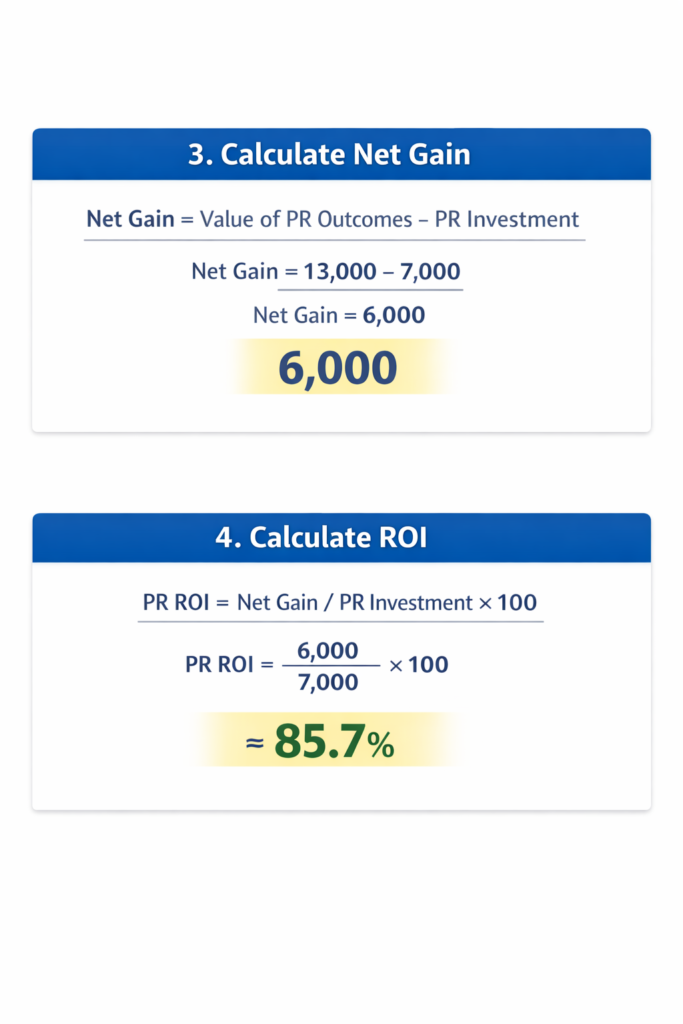
Interpretation
This means that for every $1 spent on the PR campaign, the company earned an additional $0.86 in value. An ROI of 85.7% shows the campaign was highly effective and provided measurable returns beyond the initial investment.
Now that you know how to measure PR ROI, compare digital marketing vs public relations, and opt for what suits you the most. You can also combine both to get excellent outcomes.
Conclusion
Measuring PR ROI is crucial for understanding the real impact of public relations efforts. By analyzing metrics such as media coverage, share of voice, website traffic, social media engagement, and brand sentiment, organizations gain valuable insights into how their PR campaigns influence brand visibility and public perception.
These measurements help businesses move beyond assumptions and make more data-driven decisions about their communication strategies. At the same time, evaluating PR ROI is not only about numbers but also about understanding the broader value PR brings to reputation, credibility, and long-term relationships with audiences.
By combining traditional measurement methods with modern data-driven tools and following best practices, organizations can better assess the effectiveness of their PR initiatives and continuously improve their approach to public relations.
FAQs
How can I calculate PR ROI?
You can calculate PR ROI by comparing the value generated from PR activities, such as media exposure, website traffic, leads, or brand awareness, with the cost of running PR campaigns. A basic formula is: PR ROI = (Value of PR Outcomes – PR Investment) ÷ PR Investment × 100.
What is a good PR ROI?
A good PR ROI depends on campaign goals and industry benchmarks. Since PR often focuses on long-term reputation and brand awareness, success is usually measured through improved media coverage, positive sentiment, increased visibility, and stronger audience engagement rather than immediate financial returns.
What tools are used to measure PR performance?
PR professionals use analytics and monitoring platforms such as Google Analytics, media monitoring tools, and social listening software to track metrics like website traffic, brand mentions, audience engagement, and sentiment.
What are the key KPIs in PR measurement?
Common PR key performance indicators (KPIs) include media coverage, audience reach, share of voice, website traffic from PR campaigns, social media engagement, brand sentiment, and lead generation.
Why is PR ROI difficult to measure?
PR ROI can be challenging to measure because PR focuses on reputation, credibility, and long-term brand perception. These outcomes are not always directly linked to sales, making it harder to assign a precise financial value to PR activities.
What metrics are commonly used to measure PR ROI?
Common PR ROI metrics include media coverage, media reach, share of voice, website traffic, social media engagement, brand sentiment, and lead generation.
How can website traffic help measure PR ROI?
Website traffic analysis shows whether media coverage or PR campaigns are driving visitors to a company’s website, which can indicate increased brand awareness and audience interest.
What is Share of Voice (SOV) in PR measurement?
Share of Voice measures how often a brand is mentioned in the media compared to its competitors, helping organizations understand their visibility within the industry.
What is Advertising Value Equivalent (AVE)?
Advertising Value Equivalent (AVE) estimates the cost of buying the same media space as paid advertising to measure the value of earned media coverage.
What tools can be used to measure PR ROI?
PR professionals often use analytics and monitoring tools such as Google Analytics, media monitoring platforms, and social listening tools to track campaign performance.
What challenges exist when measuring PR ROI?
PR ROI can be difficult to measure because its impact often involves long-term reputation building, indirect influence on customer decisions, and limited control over media coverage.
How does brand sentiment affect PR ROI?
Brand sentiment analysis helps organizations understand whether public perception of their brand is positive, neutral, or negative after PR campaigns.
Can PR directly generate leads or sales?
While PR primarily focuses on reputation and awareness, effective campaigns can also influence potential customers and contribute to lead generation and long-term sales growth.